
Threads
Everyone Wears the Same Cloth
Aso-ebi means "family cloth." It began as a sign of belonging and became the dress code, the guest list and the business model of the Nigerian party.
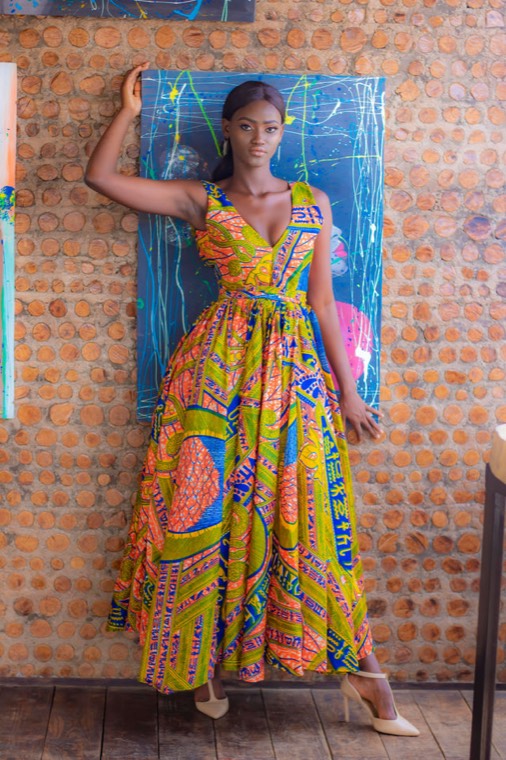
The family, in emerald.

01 / 10
It means "family cloth."
In Yoruba, aṣọ is cloth and ẹbí is family. Everyone close to the celebrants wears the same fabric, so you can see at a glance who belongs to whom.
Two lengths, the same cloth.

02 / 10
It started as belonging.
Yoruba age groups and women's clubs wore matching dress to mark their bond. By 1920, during a Lagos trade boom, aso-ebi had arrived as something new.
The matching group is older than the wedding.

03 / 10
Then the camera got involved.
From the 1960s, imported lace became an aso-ebi favorite, tailors got busy, and Lagos photographers and party magazines made every matching group a picture.
Every group needs its photo.
04 / 10
"A symbol of solidarity, love and social connections."Adeola Adeoti, Ladoke Akintola University of Science and Technology, to New Lines Magazine

05 / 10
The lace is Austrian.
Since the early 1960s, embroiderers in Vorarlberg, Austria, have made lace for Nigerian buyers. More than half of the region's embroidery still goes to Nigeria.
Heavy lace, made for Nigerian taste.

06 / 10
The bride sells it.
The celebrant picks the fabric months ahead and sells it to guests, often in a WhatsApp group. There are usually two options, one pricier. Some celebrants mark it up.
The fabric arrives months before the party.

07 / 10
And the cloth sorts the room.
At one Lagos wedding, guests in the lace got cocktails and printed souvenir bags. Guests in the cheaper wax print got canned malt and gas lighters.
Two fabrics, two experiences.

08 / 10
It has a hashtag.
In June 2013, BellaNaija launched #AsoEbiBella, a weekly feature of wedding guests in their aso-ebi. Its Instagram account grew past a million followers.
Made for the feed.

09 / 10
It travels.
In Sierra Leone and Cameroon it's called ashobi. In London and Houston, couples ship the fabric to guests, and American wedding sites now explain it.
The cloth, a long way from Lagos.

10 / 10
Know the pieces.
Aso oke is the handwoven cloth. Iro and buba are the wrapper and blouse. The gele is her headtie, the fila is his cap, and the agbada is the grand robe.
Gele, fila, iro and buba.
The Essentials, complete
You have the essentials.
Want the Austrian lace story, the WhatsApp economy and what happens when you say no? The Full Story takes about 7 minutes.
Keep reading: The Full StoryThe Full Story · 7 min
Everyone Wears the Same Cloth
In September 2021, Faith Nwachukwu was added to a WhatsApp group called "Victoria and friends."
A former colleague's eldest daughter was getting married, and Nwachukwu barely knew the bride. That didn't matter. The group existed to sell the aso-ebi, the fabric every guest was expected to wear. The first choice, a lace with gold spangles, cost ₦85,000 (about $52) for three yards, and it sold out before she could get it. She bought the backup, a wax print, at ₦48,000. With tailoring and accessories, she spent more than ₦120,000 to attend the wedding of someone she barely knew.
At the reception, she told New Lines Magazine, the guests in lace got cocktails and snacks. The guests in wax print got canned malt, bottled water and zobo. The meat ran out, and some guests left in protest. At the end, the lace guests went home with printed bags and umbrellas. The wax print guests got gas lighters.
That's aso-ebi at its most extreme. It's also the clearest picture of what the custom has become: a beautiful idea about belonging that now runs on money, photographs and group chats.
Family cloth
The name is Yoruba. Aṣọ means cloth; ẹbí means family or kin. At a wedding, a funeral, a milestone birthday or a memorial, the people closest to the celebrants all wear the same fabric. A Nigerian wedding planner told The Knot that it helps you tell the sides of the family and the groups of close friends apart, and it turns the room into a single color story.
At its best, it's exactly what it looks like. Adeola Adeoti, an academic at Ladoke Akintola University of Science and Technology, described aso-ebi to New Lines as "a symbol of solidarity, love and social connections."
Two lengths, the same cloth.
Where it came from
The anthropologist William Bascom traced the practice to Yoruba age groups, whose members wore uniform dress to mark their bond. Women's social clubs, called egbes, did the same, often with the club's emblem on the cloth, and families wore fabric printed with a loved one's portrait to funerals.
The modern version took shape in the city. The economic historian Ayodele Olukoju considers aso-ebi a novelty by 1920, during a boom in Lagos that followed the First World War, when prices for exports like palm oil climbed. In the 1950s, members of women's egbes turned up to ceremonies in matching styles, competing with rival clubs over whose cloth was richer.
The tradition of the matching group is still visible at festivals like Ojude Oba in Ijebu Ode, where peer groups called regberegbe parade in coordinated outfits.
The matching group is older than the wedding.
Lace, wax and an Austrian town
The classic aso-ebi fabric was aso oke, the handwoven cotton and silk cloth worn as iro and buba (wrapper and blouse) with a gele for women, and buba, sokoto, agbada and fila for men. After independence, demand outran how fast aso oke could be woven. Families turned to imported cloth: wax print, lace and Swiss voile. From the mid-1960s to the late 1970s, imported lace and george became aso-ebi favorites, and the demand for agbada and other handmade outfits brought tailoring back. If you read our wax print story, you know where the Ankara came from.
The lace has its own route, and it runs through a small town on the Austrian border with Switzerland. Lustenau opened its first embroidery factory in 1875, and the industry became the region's biggest employer. In the early 1960s, Vorarlberg's embroiderers and Nigerian traders started developing lace designs and qualities specifically for the Nigerian market. The curator Barbara Plankensteiner, who spent years researching the trade, calls the result "a Nigerian-Austrian creation." Nigerian traders traveled back and forth between the two countries to buy it. In Vorarlberg, the lace boom of the 1970s ran on exports to Nigeria.
The trade still matters. More than half of Vorarlberg's embroidery goes to Nigeria, according to Austria's trade agency. In February 2026, the Austrian embassy in Lagos held an event honoring more than 60 Nigerian lace sellers, and its commercial counsellor called the relationship a multi-generational partnership that dates to the 1960s. Abroad they call it African lace. In Nigeria, people call it Austrian lace.
Abroad they call it African lace. In Nigeria, people call it Austrian lace.
Heavy lace, made for Nigerian taste.
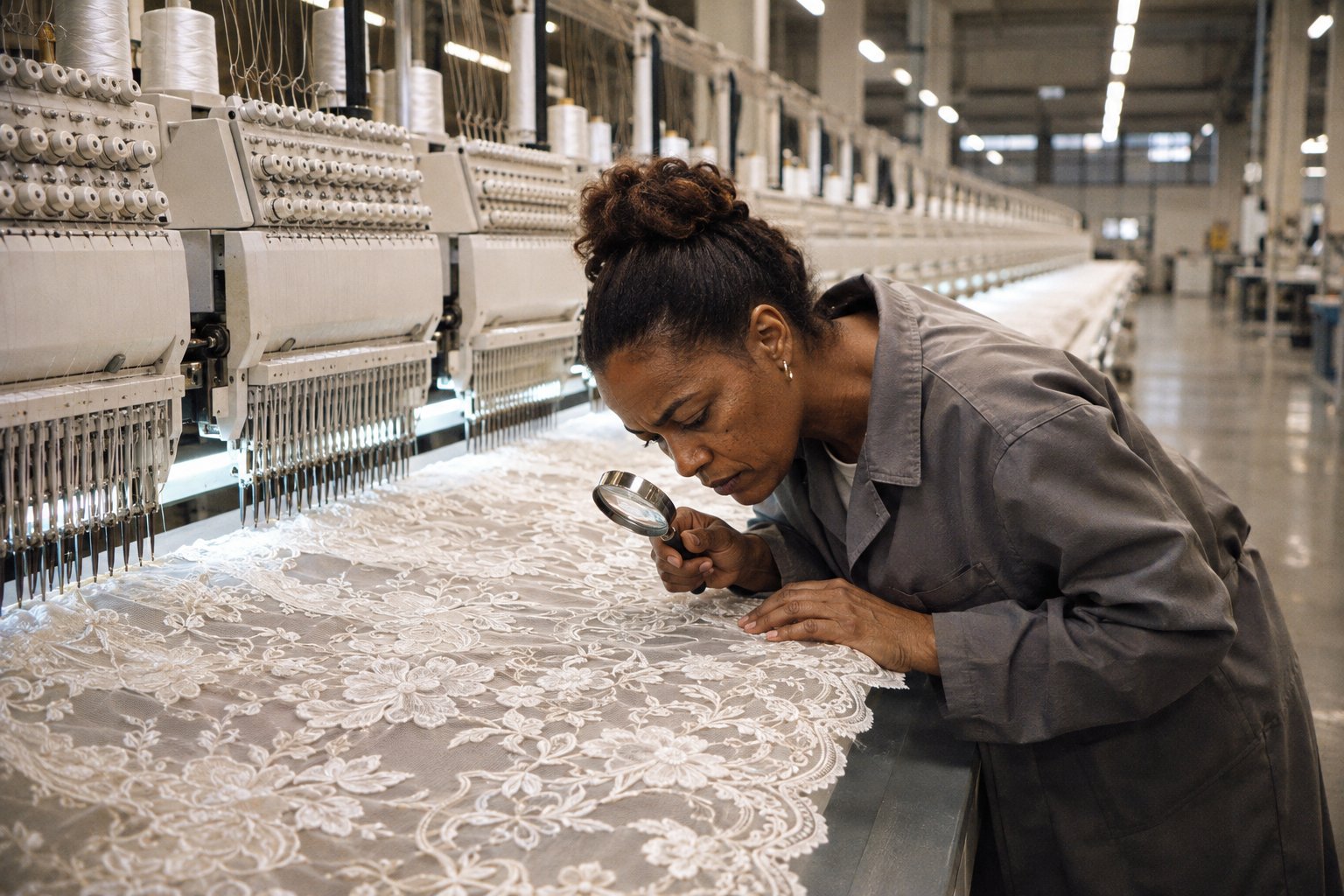
Where the lace is made.
How it works now
At a typical Lagos wedding, every guest, not just the bridesmaids, is expected to wear the fabric. The bride buys or custom-orders it months ahead and sells it to family and friends, who take it to their tailors. Usually there are two fabrics, one pricier, sold in lengths of three or five yards. The celebrant or a planner sets up a WhatsApp group to manage sales, and if the bride doesn't have enough friends to buy it all, she adds acquaintances from church, school or other events.
Lace and wax print are the most popular choices, the Lagos fabric merchant Taofeekat Badmus told New Lines. And the Lagos interior designer Florence Onamah said some celebrants raise the price of the pricier fabric to turn a profit.
The fabric arrives months before the party.
Made to be photographed
Aso-ebi was always visual, and photography made it bigger. The photographer J.D. 'Okhai Ojeikere was shooting aso-ebi groups in Lagos in the 1960s. Later, Lagos's party and lifestyle magazines turned guests into subjects: tailors studied them for designs, and their customers bought them to see if they or their friends had made it in.
The art historian Okechukwu Nwafor, whose 2021 book is the deepest study of the custom, argues that clothing, fashion and photography together created a particular kind of visibility in Lagos. He also noticed the darker side of that: with digital editing, a guest who doesn't wear the aso-ebi can simply be removed from the photo.
Then came Instagram. In June 2013, BellaNaija launched #AsoEbiBella, a weekly feature of wedding guests in their aso-ebi. Its Instagram account passed a million followers and later spun off into its own media company. Today, TikTok and Instagram creators set the trends, and the designer Esther Abejide told New Lines that many younger women now skip the traditional iro and buba for corset-style gowns.
Made for the feed.
The price of belonging
Here's the problem. Once a custom is about being seen, it's also about being seen not to take part.
Onamah told New Lines that some people borrow money to buy aso-ebi so they won't be judged. Hosts expect guests to return the favor when it's their turn, and declining or haggling reads as hostility. A Lagos bank worker described how someone who refuses gets treated as an enemy and slowly shut out. In a hard year for her family, she turned down a friend's ₦40,000 aso-ebi for a memorial. The friendship didn't survive. Some women, New Lines reported, have diverted their children's school fees to buy friends' aso-ebi.
Nwafor makes the same point more bluntly: inclusion, he argues, is now driven less by real friendship or family than by competition over numbers.
The pandemic paused it briefly, with some couples holding weddings on Zoom. By 2022 it was back, though Nigeria's cost-of-living crisis shrank the food and souvenirs at many parties. Meanwhile, the fabric business itself is under pressure. Cheaper Chinese imitations and high operating costs are hurting local textile producers, even as aso-ebi keeps growing.
Two fabrics, two experiences.
It travels
Aso-ebi has spread well beyond the Yoruba. In Sierra Leone and Cameroon, it's called ashobi, often by people who don't know where the word came from. In our wax print story, we met the Jumping Horse print, which became a favorite aso-ebi for Igbo women.
The diaspora took it too. Couples in London, Houston and Toronto often buy the fabric in Nigeria and ship it to guests, and the American wedding site The Knot now explains aso-ebi to guests who've never heard of it. The pressure travels with the fabric: in London, a 70-year-old celebrant went viral for publicly scolding the guests who hadn't bought her aso-ebi.
And if you read our Detty December story, you know where a lot of those diaspora guests end up in December: back home, at a wedding, in the cloth.
The cloth, a long way from Lagos.
So, is it worth it?
When it works, there's nothing like it. A room full of people in the same cloth is a visible promise: we showed up, we're with you, we belong to each other.
When it doesn't, it's a guest list with a price tag.
Faith Nwachukwu found her own answer. In 2024, three years after that wedding, she wore the wax print gown to church. She got plenty of compliments.
Aso-ebi is the guest list you can see.
The family, in emerald.
Sources and research
- "Kin Cloth" Brings People Together, and Sets Them Apart · Kingsley Charles, New Lines Magazine, March 2025
- Aso Ebi: Dress, Fashion, Visual Culture, and Urban Cosmopolitanism in West Africa · Okechukwu Nwafor, University of Michigan Press, 2021
- Review of Nwafor's Aso Ebi · African Studies Review, Cambridge University Press
- Aṣọ ẹbí in the 1960s (J.D. 'Okhai Ojeikere photograph, from Nwafor's Aso Ebi) · Fulcrum
- Aso ebi · Wikipedia (citing Bascom, Olukoju, Little and Nwafor)
- African Lace: an industrial fabric connecting Austria and Nigeria · Barbara Plankensteiner, Anthrovision, 2013
- African Lace: A History of Trade, Creativity and Fashion in Nigeria · Barbara Plankensteiner and Nath Mayo Adediran (eds.), Snoeck, 2010 (book)
- African Lace: Austrian Fabrics for Nigeria (exhibition, Museum of Ethnology, Vienna, 2010-2011) · Artmagazine
- "African Lace" im Völkerkundemuseum · Vienna.at
- Lace Remade in Our Image (podcast) · Bard Graduate Center
- Fashion industry overview · Advantage Austria
- Austria-Nigeria textile trade deepens · The Guardian (Nigeria), 2026
- Austria spotlights Nigeria as key market for authentic Austrian lace · Gazette Nigeria, February 2026
- ALAE honours the merchants behind Austria's finest lace in Nigeria · ThisDay, February 2026
- With indigenous contents, Touring Thread arrives Lagos · The Guardian (Nigeria)
- AsoEbiBella launches online fashion community · BrandSpur, 2017
- Meet the JA Nigeria alum behind #AsoEbiBella · Junior Achievement Africa
- #AsoEbiBella archive · BellaNaija
- Aso-ebi styles for weddings · The Knot
- Nigerian wedding attire · The Knot
- How Nigerian diaspora weddings changed aso-ebi fashion abroad · Rex Clarke Adventures
- Owambe and the business of aso ebi · WithinNigeria, September 2025
What's the best aso-ebi you've ever worn, and did you wear it again?


In conversation
0 comments
Sign in by email to comment
First comments and comments with links await review. Community guidelines